
Why being able to get up from the floor matters more than you think
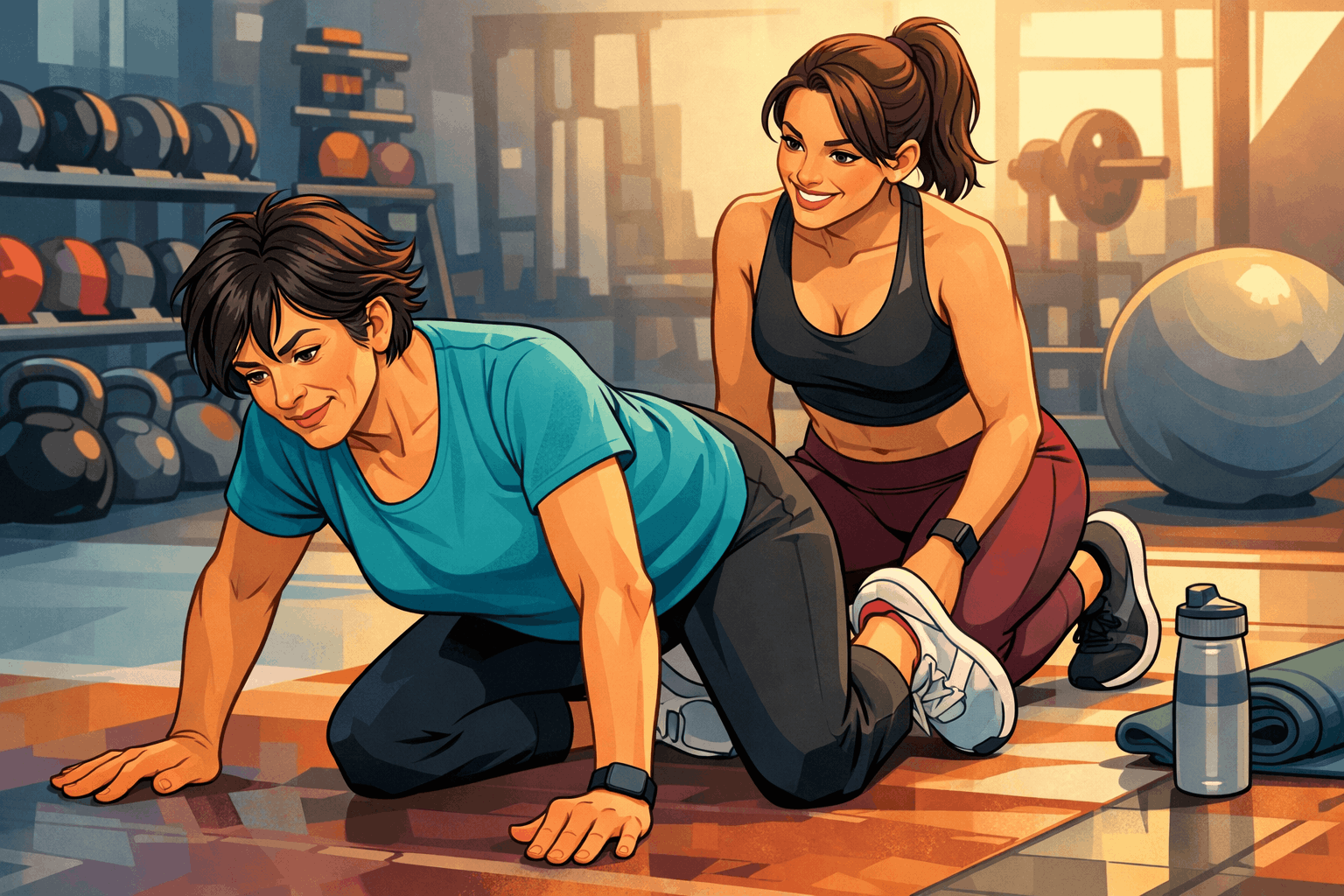
A few months ago, my mum refused to go anywhere near the floor.
Not because she didn't want to try. Because she couldn't. Her knee was painful, every attempt felt out of control, and she would literally just drop. So she stopped trying altogether. And honestly, I had been avoiding something too. I was choosing not to fully acknowledge that she's getting older, more vulnerable, and that some of what I was watching wasn't "just the way it is." It was changeable.
She's been staying with me for a few weeks now. And for the first time in our lives, I've taken her to the gym.
Not our usual catch-ups. Not restaurants or family routines. The gym. She has never exercised before, never trained, never had a programme. So we did not force strength. We changed the approach entirely.
The thing we worked on first
We focused on control. Positioning. Giving her a safe, predictable way to move that didn't feel frightening.
That meant starting from a chair. Practising the shift of weight forward over her feet before standing. Learning how to lower herself in stages rather than just falling. Building the pattern slowly, carefully, and with a lot of patience.
Within a few sessions, something shifted. She could lower herself to the floor and stand back up with confidence. No fear. No dropping. No hesitation.
I cannot tell you how much that meant. Not just to her. To me.
Why this matters more than most people realise
There is actually a body of research that links the ability to get up and down from the floor with independence, fall resilience, and longevity in older adults. The floor sit-rise test — where you sit cross-legged on the floor and stand back up without using your hands or knees for support — was shown in one well-known study to be a strong predictor of all-cause mortality in adults over 51. Each point of support used to get up or down reduced the score, and lower scores correlated with significantly higher risk.
That sounds clinical. But what it means in everyday life is this: the ability to get down to and up from the floor tells us a great deal about a person's strength, balance, flexibility, and coordination all at once. It is a functional test of whether your body can handle the unexpected.
Because falls in older adults are not just about the fall itself. They are about what happens next. Can you get back up? Can you manage without help? Can you stay calm enough to do so?
That is what we were really training for.
What "floor mobility" actually involves
Getting up from the floor is not one skill. It is several. And if someone is struggling with it, the problem is usually one of three things: weak legs, poor hip mobility, or a lack of the pattern itself. They have simply not practised it enough to feel safe doing it.
A few things that help:
Practise sitting to a low surface first. A low chair or a step before the floor. Build the confidence that you can control the lowering before removing the support entirely.
Use a wall or a sturdy piece of furniture nearby. Not to lean on heavily, but as a safety anchor. The goal is to rely on it less over time.
Work on hip flexor and hip mobility separately. A lot of people find floor transitions hard because their hips are very tight from years of sitting. Gentle hip circles, kneeling stretches, and cat-cow movements done consistently make a real difference.
Practise the transition itself, slowly. From standing, to kneeling, to sitting, to the floor. Then back up. Do it slowly and deliberately. The pattern needs repetition before it feels natural.
None of this requires a gym. A clear space on a carpet or a mat at home is enough to start.
This is bigger than fitness
What I noticed most with my mum was not the physical change. It was the shift in how she held herself. The way she moved through the house differently. The fact that she stopped bracing every time she sat down.
That is what this kind of training gives people. Not aesthetics. Not a number on a scale. A sense of capability in their own body that most of us take for granted until, suddenly, we don't have it anymore.
If you are watching a parent struggle with movement, or if you are starting to notice these things in yourself, it is worth paying attention early. The longer the habit of avoidance goes on, the harder it becomes to reverse.
If you're based in Guildford or the surrounding Surrey area and would like some support with this, I'd love to help.